Wankel Car Engine
- The Rotary Design
 |
|
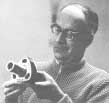
Dr.
Felix Wankel
|
|
|
|
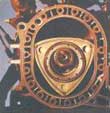
Mazda
Engine 1970
|
Rotary engines
produced for cars today are all the Wankel type, named after the
German inventor Dr. Felix Wankel. Although only in production
since 1964, the Wankel engine may one day challenge the supremacy
of the conventional piston engine.
Its greatest advantage being everything goes only round and round
(no up and down motion). It is lighter, more compact and has fewer
moving parts than a piston engine.
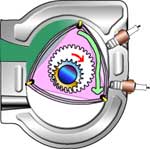
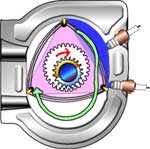
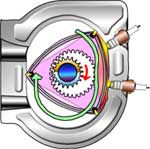
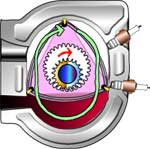
Firing
Circle of the Wankel Rotary Engine
(The cycle goes on in all
three chambers simultaneously.)
 |
 |
 |
 |
Induction:
As the tip of the rotor passes the inlet port, the petrol/air
mixture enters the following chamber, which is increased in
size because of the rotors eccentric orbit as the rotor rolls
around the central gear.
|
Compression:
As the rotor continues to revolve, the chamber containing
the mixture decreases in size and the mixture is compressed. |
Power:
Spark plugs ignite the mixture. Ignition causes the mixture
to burn and expand, imparting energy to the rotor for its
power `stroke' as the size of the chamber increases.
|
Exhaust:
The leading lobe passes the exhaust port and leaves it open
for the burnt out gases to escape.
|
| |
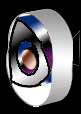 |
The
shapes of the rotor and the working chamber are inter-related
and influence the power output of the engine. |
Wankel
has a fixed casing. The output shaft turns at 3 times the rotor
speed. The three rotor tips are continuously in touch with the
internal surface. Between the three sides of the rotor and the
inside of the casing are three working spaces, or chambers, each
of which alernately expands and contracts in size as the rotor
`orbits'. Hence there are three power strokes for each rotor revolution.
Although most Wankel engines have a carburettor, some have been
operated with fuel injection. The Wankel is essentially a water-cooled
engine with oil-cooling for the rotor.
The Principle:
The principle of working is similar to the 4 stroke car engine.
The petrol/air mixture enters and is compressed. Into this compression
is ignited a spark (power stroke) which burns the mixture causing
it to expand as gas. This energy of expansion turns the triangular
rotor, which in turn turns the central gear. The central gear
turns the shaft which turns the flywheel. The turning of the flywheel
goes through various gears and finally turns the wheels.All these
combined with the fact that there are three power strokes for
each revolution (since the cycle goes on in all three chambers
simultaneously) makes the Wankel engine tremendously powerful
for its size.
|
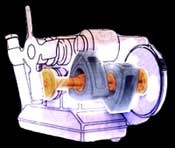
A
typical Wankel Engine with twin rotors
|
|
|
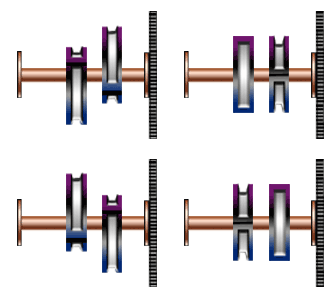
Two
rotors are combined in an engine to develop greater power.
They are correctly phased for smoothest running. Rotors
are 180 degrees to each other for best mechanical balance.
|
 |
Sealing of gases:
Efficient gas seals have to be provided at the three tips or the
rotor and its side. The development of effective and durable seals
has been a major problem.
|
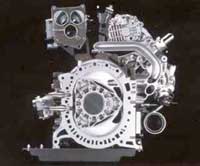
A
new rotary engine sports car
|
|
|
Mazda
has shown a new rotary engine sports car in Tokyo in October
1999. It is a four seater called the RX-Evolv. This is a
concept car with a lot of advanced technology. It sure is
exciting and it seems that something is likely to be sold
in the next year or two.
|
 |
|