|
Autorickshaws
- The EV Alternative
Abstract.
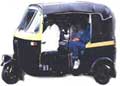 The
three wheeled, two stroke petrol engined Autorickshaw is
the dominant form of public transport in most Indian cities.
It has also been identified as a primary cause of gaseous
emissions resulting in significant air pollution and the
premature death of many. The
three wheeled, two stroke petrol engined Autorickshaw is
the dominant form of public transport in most Indian cities.
It has also been identified as a primary cause of gaseous
emissions resulting in significant air pollution and the
premature death of many.
This paper will trace the development of the battery powered
Autorickshaw with special emphasis on the larger 8-10 passenger
"Tempo" style of vehicle from the early trials in Kathmandu
to the establishment in 1999 of new designs and full scale
production.
In addition to discussing the technical features of the
vehicles, the paper will detail their operational characteristics
such as range and detail the infrastructure requirements
i.e. battery charging and changing facilities. Most importantly
the overall economics of the use of the Electric Autorickshaw
will be discussed.
While Governmental support for these projects has been available
in both India and Nepal, the paper will look forward to
the hurdles still to be crossed and how technology and financial
support will both play a part in the future development
of Electric Autorickshaws.
While the pure battery car may never meet the needs of the
American and European motorist, the Electric Autorickshaw
represents a real EV alternative today on the highly congested
and polluted streets of India and South East Asia.
Introduction
Air pollution is today one of the greatest threats to
both the health and future prosperity of India. There were
an estimated 2.5 million premature deaths caused by air
pollution in India in 1997 and according to a recent World
Bank study, poor urban air quality is costing India billions
of dollars in increased health care and lost productivity.
At a time when India is trying hard to increase tourism,
the streets of Delhi and even "the Garden City" of Bangalore,
can only be walked with a handkerchief held up to your streaming
eyes and sore throat.
Much of the blame for this situation must be levelled at
the every increasing volume of road traffic. A high proportion
of these vehicles use two stroke engines where as much as
40% of the fuel is lost as hydrocarbon emissions. Based
on figures produced by USAID these vehicles account for
70% of the air pollution in the inner city areas of the
major cities of India.
PRODUCTION OF VEHICLES IN INDIA - TWO & THREE WHEELERS
|
YEAR
|
TWO WHEELERS
|
THREE
WHEELERS
|
|
1991
|
1,603,108
|
79,429
|
|
1993
|
1,664,427
|
77,498
|
|
1996
|
2,551,166
|
153,318
|
|
2000
Projection
|
3,500,000
|
250,000
|
Most of the city streets
in India today are highly congested. Average speeds are seldom
more than 25 km/h and daily distances rarely exceed 100 km.
A typical journey will include multiple stops and starts.
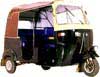 One
key mode of transport in many Indian cities is the Autorickshaw.
Developed to meet the unique combination of congestion and
the demand for low cost, flexible public transport, the "Auto"
as it is generally known has developed in two specific versions.
This is a three-wheeled petrol or diesel engine vehicle. The
smaller and more common model is used as a free roving taxi
carrying three passengers and, while restricted from some
parts of cities, can basically travel anywhere. The larger
vehicle, often known as a Tempo, carries up to 8 passengers
and runs a fixed route typically carrying passengers from
the outer suburbs into and out from the city centre. These
vehicles are known to be amongst the worst polluters and have
been targeted by cities such as Delhi and Lucknow to be phased
out and banned. One
key mode of transport in many Indian cities is the Autorickshaw.
Developed to meet the unique combination of congestion and
the demand for low cost, flexible public transport, the "Auto"
as it is generally known has developed in two specific versions.
This is a three-wheeled petrol or diesel engine vehicle. The
smaller and more common model is used as a free roving taxi
carrying three passengers and, while restricted from some
parts of cities, can basically travel anywhere. The larger
vehicle, often known as a Tempo, carries up to 8 passengers
and runs a fixed route typically carrying passengers from
the outer suburbs into and out from the city centre. These
vehicles are known to be amongst the worst polluters and have
been targeted by cities such as Delhi and Lucknow to be phased
out and banned.
Where are we
today ?
Today India imports 55% of its oil based fuel. India
does however produce all its own electricity from coal and
hydro-electric power stations. Electric vehicles are not new
in India.In fact India has been one of the pioneering countries
to start exploring commercialization aspects of Evs, in 1980s.
Over the years the country has experimented with battery powered
bicycles, scooters and buses but none of these projects has
made a significant impact.
In 1996 in Kathmandu, Nepal a development project was initiated
by USAID to put a small fleet of battery powered Tempo autorickshaws
into the city. These became known as Safa Tempos. The vehicles
have been well received and the project has found private
investment as well as good support from both the local and
national government. Since that time the fleet has grown to
almost two hundred vehicles and they have begun to make a
very real impact in reducing the air and noise pollution in
Kathmandu which is both a thriving capital city and an environmentally
critical tourist centre.
In
Nepal it has been seen that passengers prefer to travel
in the Safa Tempos, often letting a standard vehicle pass
and waiting for the EV. They claim the major benefits are
a smoother and quieter ride without the hazard of the exhaust
fumes penetrating into the largely open passenger compartment
of the vehicle. In Kathmandu they will also pay a 25% premium
for the Safa Tempo.
Based largely on the experience gained in Nepal, at least
three significant projects have begun in India with two
major manufacturers at the stage of pilot production. Key
features of the Indian vehicles are as follows:
1 ) Vehicles
have been designed specifically for Indian city use as point
to point taxis carrying 8 - 10 passengers at a top speed
of 40 km/h..
2 ) Vehicles have been designed for minimum cost
so that they can be offered ( less battery ) at only a small
premium over equivalent engine powered vehicles.
3 ) The current lead acid batteries are designed
to give 80 km range and to be easily removed and changed.
Up to three batteries are to be provided with each vehicle
to give a 240 km daily range. As new battery technology
is developed, such as nickel metal hydride, so the need
to change batteries will diminish.
4 ) The latest vehicles feature Curtis SepEx or separately
excited DC motor speed controllers. These provide active
regenerative braking, electronic control of forward and
reverse direction, programmable top speed control and reduced
maintenance.
Critical to the success of these new projects will be the
establishment of a battery charging and vehicle maintenance
station infrastructure. To succeed this will require the
ongoing support of both National and local governments.
The future.
The Kathmandu experience has taught us that without proper
maintenance, battery life and vehicle reliability will suffer.
This is why Curtis Instruments has sponsored training programmes
in Nepal and elsewhere. With the larger Tempo style of vehicle,
which runs along a fixed route, it is possible to set up
a battery charging station where batteries are changed,
recharged and vehicles are maintained. The ownership of
the station and, if necessary the batteries themselves,
can be held separately from the vehicles. Charging stations
can be positioned to service more than one route, making
an appropriate monetary charge for each battery recharge.
In this way the higher initial cost of the EV Tempo can
be off set by the lower running costs from lower fuel and
maintenance costs. The charging stations will also support
other EVs such as scooters and door to door delivery vehicles.
Income for
the Tempo vehicle operator is based on 1 Rupee per passenger
kilometre and equates to between 1000 to 1500 Rs per day.
The typical cost of the EV Tempo is 150,000 Rs plus 120,000
Rs for three battery packs. An autorickshaw driver earns
approximately 100 Rs per 8 hour shift. Given these economics
it is possible to show a payback for the vehicle operator
of 2 to 3 years and to the charging station owner operator
of 3 to 4 years.
Given the commercial
risks involved it may well be that the local and national
governments will have to look favourably upon these investments
in order to accelerate their application to the obvious
benefit of the environment. Areas to consider are:
1 ) Provision of low or even zero cost sites close
to city centres for the provision of charging stations.
2 ) Beneficial tax breaks for investors in EV Tempo
projects.
3 ) Zero duty to be paid on key imports in support
of EV programmes ( in Nepal 1% duty is applied) to reduce
the initial capital cost of the vehicle.
4 ) Higher tax / duty on hydrocarbon based fuels
used for transportation.
5 ) Consideration of banning engine powered vehicles
in sensitive and critical areas such as close to the Taj
Mahal in Agra., or creating 'zero emission vehicles only'
zones in crowded areas in cities.
6 ) Provide increased levels of subsidy for EV demonstration
programmes.
7 ) To encourage overseas governmental and non-governmental
bodies to participate in EV. programmes and the establishment
of the necessary infrastructure to support them. 8) Introducing
time-of-use rates for electricity thus encouraging the future
EV customers to charge the EV s in off peak hours at a considerable
discount in tariff.
Often western
technologies are not directly applicable to Indian conditions
because of differences in climate, infrastructural support,
cultural habits etc. Before introducing new technologies
in batteries or motor-controllers such as NiMH batteries
or AC Motor controllers , their techo-commercial acceptance
in Indian market conditions will have be studied from this
angle.
Conclusion
While it is true to say the IC Engined vehicles make up
the majority of vehicles in the world today, there are a
number of niche applications where battery powered vehicles
dominate. This occurs only when there is an economic, operational
and environmental benefit. Current examples include Golf
Carts, Materials Handling Equipment in warehouses and airports,
door to door delivery vehicles in city centres i.e. Milk
Floats.
 The
unique combination in India today of congested streets with
slow moving traffic, imported fuel and desperate air pollution
is an ever deteriorating spiral. Urgent measures are necessary
to reverse the situation and one answer may be the introduction
of low cost, indigenous, battery electric autorickshaws.
There are today very distinct operational and environmental
benefits and the economics can be improved by the positive
intervention of government together with the establishment
of a critical market size, which will enable manufacturers
to reduce costs. The
unique combination in India today of congested streets with
slow moving traffic, imported fuel and desperate air pollution
is an ever deteriorating spiral. Urgent measures are necessary
to reverse the situation and one answer may be the introduction
of low cost, indigenous, battery electric autorickshaws.
There are today very distinct operational and environmental
benefits and the economics can be improved by the positive
intervention of government together with the establishment
of a critical market size, which will enable manufacturers
to reduce costs.
Richard
Sadler
Curtis Instruments (UK) Ltd
51,Grafton Street
Northampton, NN1 2NT
UK
Tel: 44(0)
Fax: 44(0)
E-mail: |
Vidyadhar
Humnabadkar
Curtis Instruments India
1206 B/7 Apte Road
Shivaji Nagar, Pune 411004
India
Tel:
Fax:
E-mail:
|
|